
Frisco Previous Residents by Era
The backward trail for a Frisco address has different sources for different periods. Frisco county deed records identify recorded owners and transfers. Frisco household material can add who was listed at an address or in the local community, but it has its own gaps. Start with the source closest to the period being studied, and preserve its limitation with the result. A Frisco title chain is not an occupancy history, while a Frisco telephone entry or obituary is not proof of title.
| Source | Years It Covers | Where Held | What It Shows |
|---|---|---|---|
| Collin current deed index for Frisco parcels | 1963-present | Collin County Clerk public search | Grantor, grantee, date, legal description, volume/page or instrument details; image access can vary |
| Collin historical index for Frisco parcels | 1843-1963 | County portal, Heritage guide, and office/history copies | Index-to-book deed chain; older initials and spelling variation matter |
| Denton deed search for Frisco parcels | Guide says 1851-present; live index publishes 1854-current | Denton County Clerk public search | Index or OCR record discovery; free registration is required for downloads in the guide |
| Frisco permit system | Historical start not stated | Frisco eTRAKiT | Site, permit, project date, contacts, and inspections; not a title record |
| Frisco telephone directory | December 1958 artifact | Frisco Heritage visual archive | An eight-page telephone and address clue, not a complete directory run |
| Federal and local census for Frisco | 1910 local collection; federal schedules through 1950 publicly available | Heritage, NARA, FamilySearch, and HeritageQuest | Household and geography clues; later schedules follow the 72-year release rule |
| Frisco Sanborn map | May 1949, four sheets | Library of Congress | Building footprint, material, use, and street context, not occupant names |
For a recent Frisco transfer, begin in the current county index. For a Frisco property that predates the current index, follow the historical books or Denton search back by legal description. Use permits, maps, newspapers, directories, and census material to test Frisco dates and household context after the deed path is in hand.
Frisco Past Residents Begin With Parcels
Frisco is a Collin and Denton County city. The mailing city on an envelope does not identify the county clerk or appraisal district for a Frisco parcel. First locate the Frisco parcel in Collin CAD or Denton CAD and retain the property ID, geographic ID or X-Ref, situs, owner mailing address, legal description, subdivision, block, lot, and tax year for that Frisco parcel. The site address is the situs. The owner mailing address receives correspondence and can be somewhere else, so it may locate an owner without establishing that the owner lived at the parcel.
Legal description is the stable bridge when a Frisco street label changes or a tract is replatted. Frisco planned subdivisions may use lot, block, and subdivision terms. Older Frisco land can use an abstract, survey, or Original Donation description. If a Frisco parcel was merged, divided, or replatted, search both the parent description and the newer lot or block. The Frisco CAD sales or deed-history field is a lead to the instrument, not a replacement for the recorded deed.
Note: Keep the county and legal description with an address search, because Frisco's city name alone does not identify the deed custodian.
Frisco Past Residents and Deed Years
Frisco has unusually clear historic deed paths. The Collin Heritage guide for Frisco separates historical index and book research from 1843 through 1963 from a current search path for Frisco after 1963. The Denton Heritage guide for Frisco says deeds can be searched back to 1851, while the live official page reports its full index from May 12, 1854 to the current system date. This county split within Frisco is important for past residents because the same modern city can produce an older filing in either county.
Older Frisco digital material has real gaps and search quirks. The Collin historical workflow for Frisco uses year buckets and SUB pages. Denton guidance for Frisco says quotation marks do not work for its search, early deeds may use initials or last-name variants, and narrowing by decade helps. The Texas State Library's Frisco-area Denton microfilm guide lists deed records and direct/reverse index reels, but notes that Volume 61 was missing at filming and that Volumes 75 and 78 were not filmed because of cutoff dates. Record those gaps instead of treating silence as proof that a transfer did not occur.
Tracing Frisco Past Owners Through Deeds
A Frisco chain of title is the sequence of recorded transfers for the same land. Build it backward from the current Frisco appraisal owner, while recognizing that an appraisal owner need not be the current occupant. The method changes at the Collin 1963 divide and at the county line, but the core rule does not: confirm each earlier transfer with its Frisco legal description before moving to the next name.
- Find the Frisco parcel in the correct CAD record and copy the current owner, situs, legal description, subdivision, lot/block or abstract, and property identifier.
- Search the current Frisco owner as grantee in the matching Clerk's land index. Open the purchase instrument and compare the legal description with CAD.
- Record the Frisco deed type, recording date, instrument number or volume/page, named parties, and every legal-description phrase. The seller is the grantor.
- Search that Frisco seller as an earlier grantee, then repeat the comparison. Check initials, alternate spelling, maiden names, and the parent tract when the description changes.
- At Frisco's Collin historical cutoff, use Historical Index Records, the year bucket, last-name letter, and SUB page to find the book/page. For Denton, use index search for grantor/grantee work and OCR only when a name may appear in the document text.
- If the Frisco web image or index is incomplete, use the Clerk's counter, a specific document request, historical books or microfilm guidance, and the Heritage deed instructions. Account or cart rules can apply to document images and downloads.
- Grantor
- The person or entity transferring an interest in a recorded deed, commonly the seller in a purchase transaction.
- Grantee
- The person or entity receiving that interest, commonly the buyer. In a backward search, a former grantor is often the next earlier grantee.
- Chain of title
- The linked series of recorded instruments affecting the same legal parcel. It is a title trail, not a complete list of residents.
- Legal description
- The lot, block, subdivision, abstract, survey, or other recorded land description that ties a deed to the right parcel more reliably than a street number.
The Collin County land-record search is the current entry point for the Collin side. When the land crosses county lines, the Denton Heritage guide warns that a deed can be filed in both counties, so search the matching filing path rather than assuming one county tells the full story.
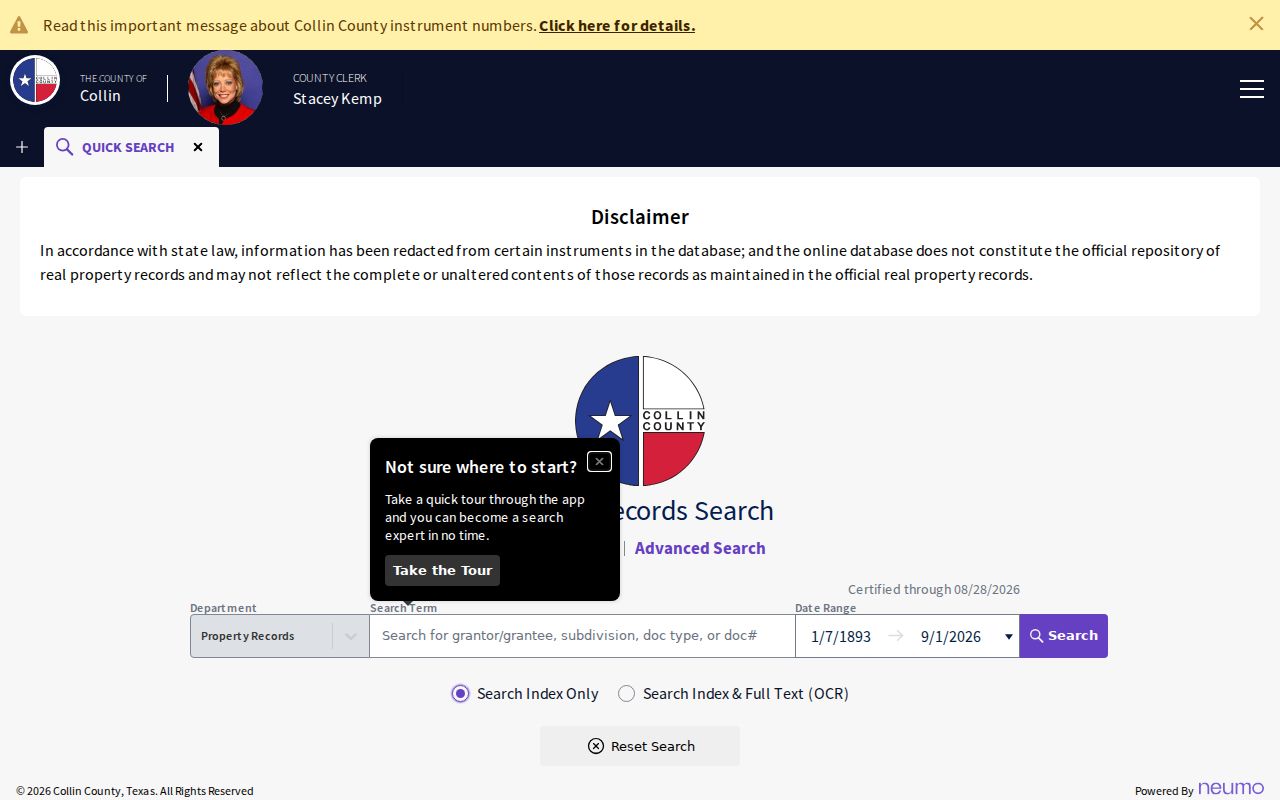
The county index is the discovery point for parties, dates, and the instrument trail that must be checked against the parcel's legal description.
Frisco Permits Date the House
Frisco eTRAKiT can place changes at a Frisco property on a timeline. The public Frisco interface has Search By, Search Operator, and Search Value controls. Its published sample exposes a Frisco address, APN, subdivision, tract, block, lot, permit type and subtype, status, applied, approved, issued, and finaled dates, project contacts, fees, inspections, reviews, and linked activities. That is valuable for separating a Frisco building event from a later deed transfer.
The system's Frisco historical start date was not stated in the research. A 2001 sample demonstrates that older Frisco records can appear, but it does not establish complete coverage from that date. An owner, applicant, or contractor named on a permit is tied to a project or transaction. Do not treat the name as proof of residence. When the Frisco online result stops, use a specific written City request or ask the relevant division where the Frisco municipal file is held.
Frisco House History Map Clues
Frisco Heritage offers a local house-history channel beyond the Frisco county indexes. Its Historic Sites Committee can assist with Frisco property research and provide documents or photographs from its Frisco archives. The application asks for the property location, old-record research, Frisco source citations, and oral-history informant details. It uses examples such as a 1902 townsite auction lot or a moved house from a neighboring village. Treat oral recollection as a lead and document who supplied it and when, then corroborate it with a deed, map, census, newspaper, or permit.
The Frisco Heritage house-history resources describe the deed, census, archive, and historic-site research path.
Heritage research adds locally held context to the official chain, but the underlying deed and parcel records remain the way to verify a specific transfer.
The Library of Congress has a public-domain Frisco Sanborn Fire Insurance Map dated May 1949, made up of four sheets. It can show a building footprint, material, use, and street context in the mapped town area. It does not name occupants. Absence from the map does not mean a property did not exist; it may have been outside the map's coverage or outside that edition's town area.
Frisco Past Residents and Old Names
Search historic place names before deciding that an address trail has ended. The railroad town began as Emerson in 1902, then used Frisco City and later Frisco. Lebanon and Erudia residents and businesses moved into the townsite. A record for a family connected with a current Frisco address may be indexed by either county or by a neighboring community rather than the modern postal city.
Heritage identifies the Original Donation as Maple Street on the north, Ash Street on the south, County Road on the east, and John Elliott on the west. That frame helps interpret older maps and deeds but does not describe all of present Frisco. No official source found a documented citywide street-renumbering event, so no conversion should be guessed. Compare plats, legal descriptions, and historic maps instead.
Frisco Previous Residents Beyond Title
Owners are only one layer of the address story. A historical reverse or criss-cross directory can connect an address to an occupant or telephone entry, but the exact Frisco printed run was not located in the inspected public catalog pages. Frisco Heritage documents a December 1958 Southwestern Bell directory as an eight-page artifact, not a full run. The Frisco Public Library provides America’s Newspapers, FamilySearch, Fold3 Library Edition, and HeritageQuest as research resources, while the Portal to Texas History has digitized Frisco newspapers from selected decades.
Use the household layer as a dated comparison, not as a substitute for the title chain. Frisco Heritage's collection includes 132 documented family histories and a local transcription of 82 families in the first official 1910 Frisco census across Collin and Denton Counties. Its obituary archive runs from 2004 forward but is descendant-contributed and incomplete. Cemetery material, probate files, and newspaper notices can add an endpoint, then need corroboration where possible.
Pair the household sources in chronological order:
- Place the deed transfer on a timeline using its recording date and legal description.
- Check the nearest known telephone, reverse-directory, newspaper, or local collection clue for the same address, surname, or historic place name.
- Pair a directory year with the closest available census. The 1910 local Frisco collection is especially useful, while federal schedules after 1950 remain subject to the 72-year release rule.
- Use an obituary, cemetery entry, probate filing, or newspaper image to test a move, death, family relationship, or former community label.
- Return to the legal description when a name appears more than once. A matching surname without the right parcel is not enough.
Exact Frisco reverse-directory years should be confirmed with a librarian, the Texas State Library and Archives Commission, or the UT Dolph Briscoe Center. The broader collection method is available on the Frisco city directory page.
Lawful use. Frisco house and family history research should remain personal and lawful. Do not use information about past or living people to stalk, harass, intimidate, or harm anyone.