
Frisco City Directory Collections
Frisco city directories are best approached as a distributed Frisco historical collection. The strongest local starting point is the Frisco Heritage Association's Frisco Families collection, which documents 132 family histories and 82 families in its local 1910 census material. It sits beside obituary and cemetery research, not beside a verified continuous printed directory run. A Frisco search can move from that local evidence to the library, university scans, census schedules, and land records when a name or address needs another check.
| Collection | Years | Where Held | Access |
|---|---|---|---|
| Frisco Families and local census | 132 histories; 82 1910 families | Frisco Heritage Association | Online family-history material |
| Frisco Heritage obituary archive | 2004-current | Frisco Heritage Association | Online, contributor-based and incomplete |
| History of Frisco 1902-1976 | Compiled in 1976 | UNT Portal to Texas History and Frisco Library reference | Searchable digital copy or reference access |
| Frisco Rustler, Enterprise, and Journal | Visible digitized material is concentrated in the 1940s, 1960s, and 1970s | UNT Portal to Texas History | Free online browse and search, not a complete run |
| Southwestern Bell telephone directory | December 1958 | Frisco Heritage visual archive | Eight-page historical snapshot |
| Texas telephone and city directories | Roughly late nineteenth century-present for many Texas towns | TSLAC, UT Briscoe Center, and Frisco local-library research | Ask a librarian or archive to confirm Frisco holdings |
No exact Frisco Polk, Carroll, reverse, or criss-cross year run was located in the public library and archive material reviewed. That is a real Frisco gap, not proof that no volume exists. The Texas State Library city-directory guide directs researchers to on-site holdings and the University of Texas Dolph Briscoe Center. Search catalog terms for Frisco, Collin County, Denton County, telephone directory, city directory, Polk, reverse directory, and criss-cross before treating a Frisco web-search absence as final.
Frisco City Directory Library Paths
The Frisco Public Library genealogy resources supply the research layer that printed city directories often provide elsewhere. America’s Newspapers, FamilySearch, Fold3 Library Edition, and HeritageQuest can connect a surname to newspaper notices, census material, military context, or family-tree leads. The library is at 8000 Dallas Parkway, and its published phone number is 972-292-5669. Ask about catalog entries, access conditions, collection dates, and whether a name is searchable before making a special trip.
The library is a fallback, not merely a convenience. If a Frisco city directory year is unconfirmed, a Frisco librarian can help distinguish a local reference item from a statewide database or an interlibrary-research lead. Heritage's Historic Sites Committee also works from cited deeds and census material and can provide archive documents or photographs for a documented Frisco property-history inquiry.
The library genealogy page shows the Frisco city directory research databases available through the local library.
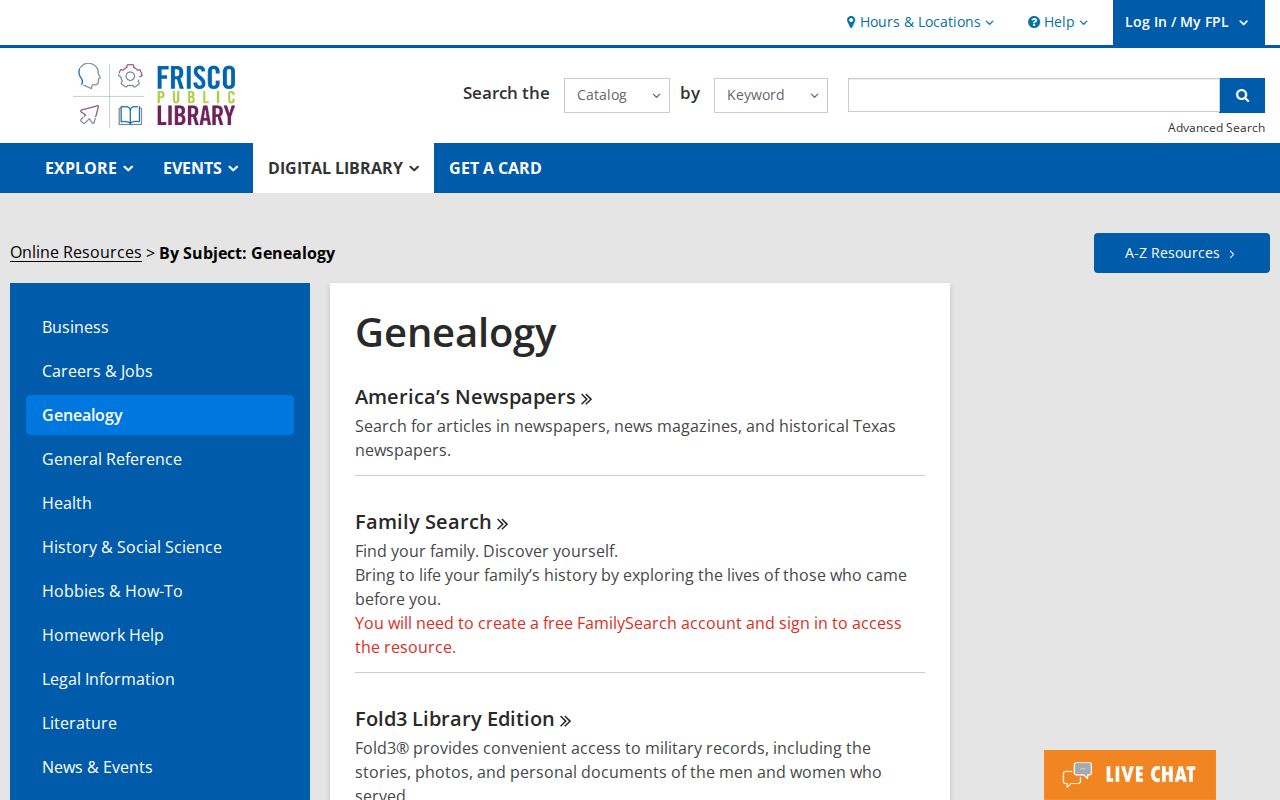
Those database choices make it possible to test a directory-like name or address clue against a newspaper, census, or family-history source instead of relying on one transcription.
Frisco City Directories Beyond Print
A historical Frisco city-directory search needs a clear fallback chain here. Start with Frisco Heritage for the family, census, cemetery, and obituary layer. Then use the Frisco library's genealogy databases and the UNT newspaper collection. After that, ask the local library, TSLAC, or the Briscoe Center to confirm whether a physical telephone, city, reverse, or criss-cross volume exists. A county deed guide can turn a Frisco address clue into a legal-description trail, but it does not replace a directory.
Do not substitute a Dallas or Sherman volume for Frisco evidence. A contemporaneous North Texas directory can teach reading conventions, but it cannot establish that a Frisco household appeared in that book. Likewise, a newspaper notice may place a person in the community without proving a street address. Keep the source, date, spelling, and image or page reference with every result.
Note: An archive confirmation is needed before claiming a published Frisco city-directory year or a local reverse-directory run.
Frisco's 1958 Directory Snapshot
Frisco Heritage documents a December 1958 Southwestern Bell Frisco telephone directory with eight pages, including covers and advertising. It is a useful historical telephone and address clue for that month. It is not evidence of a full local telephone-book sequence, and it should not be stretched into a claim about every Frisco household.
Pair the snapshot with a deed, a census entry, a newspaper notice, or a cemetery and obituary record. A telephone listing may show that a name and address were associated at one point, while the companion record can establish the property, family relationship, or time range. That narrow use makes the artifact more reliable for Frisco family research.
Reading a Frisco City Directory Entry
A Frisco-specific printed entry page was not located, so the following is a reading model rather than a claim about an unverified Frisco volume. An archival 1910-1911 Sherman city-directory page on the Portal to Texas History shows the common North Texas pattern: surname and given name, a spouse in parentheses, work or business context, a residence or boarding marker, and a street address. OCR can miss initials and punctuation, so inspect the scanned page itself.
| Name | Record the surname, initials, suffix, and spelling exactly as printed. |
|---|---|
| Family clue | A spouse, relative, widow notation, or boarder can separate two people with the same name. |
| Work context | An employer, business, or role can help locate a newspaper notice or advertisement. |
| Address marker | A residence or boarding marker and street number are leads to a map, deed, or census check. |
| Page context | Advertisements and telephone listings elsewhere in the volume can explain an abbreviation or business name. |
- Criss-cross directory
- The street-order part of a directory that can lead from an address to a listed household or business.
- Householder index
- An alphabetical finding aid focused on the person recorded as the household contact.
- Abbreviation key
- The explanatory list, often near the beginning of a volume, that defines the publisher's short marks. Photograph it before interpreting an entry.
These features are tools for reading a historical page, not proof that every Frisco city directory used the same symbols. Verify the key in the exact volume and preserve uncertainty when the page or key is missing.
Frisco City Directory Name Changes
Older Frisco records may be filed under more than one place name. The railroad town began in 1902 as Emerson, became Frisco City, and then Frisco. Homes and businesses moved from Lebanon and Erudia into the new townsite. A person in the local 1910 material may therefore be indexed by Collin or Denton County, by an older community name, or by a form of the name that does not match a modern mailing label.
Search Frisco, Frisco City, Emerson, Lebanon, and Erudia, then compare the result to an address, a relative, or a legal description. Frisco's original donation boundaries, identified by Heritage as Maple Street north, Ash Street south, County Road east, and John Elliott west, can also help place a historic property. Former names widen a search without turning a close name match into proof.
Frisco City Directory Years in Newsprint
The UNT Portal to Texas History's Frisco partner collection is the strongest digitized bridge between sparse directory evidence. It includes items from the Frisco Rustler, Frisco Enterprise, and Frisco Journal, with the visible digitized material concentrated in the 1940s, 1960s, and 1970s. Search a surname with a school, church, business, street, or old place name. Newspaper results can supply dates and community context that a telephone listing cannot.
The UNT collection displays Frisco city directory companion material in digitized newspaper and local-history records.
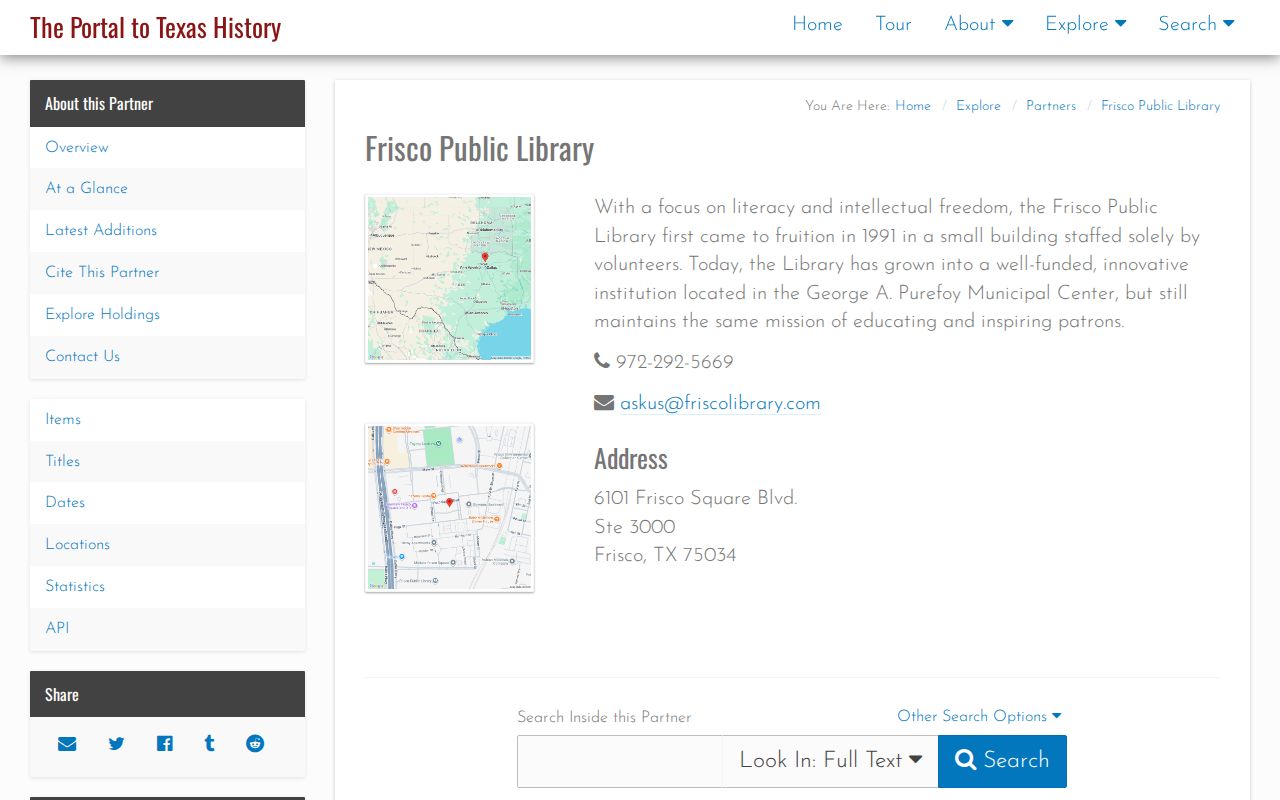
A newspaper hit should be saved with its issue date and page image, then compared with a census, Heritage family page, or recorded deed before it is used to extend a household trail.
Tracing Frisco City Directory Households
Use the local collections to build a household sequence rather than trying to force a single source to answer every question. The 1910 Frisco collection spans both counties, so county assignment matters. When an address surfaces in a Frisco city directory clue or telephone artifact, compare it with the closest released federal census and then use recorded deeds, probate, obituaries, or permits to test continuity.
- Begin with a known name, address, cemetery entry, obituary, or the Frisco 1910 census family.
- Record the exact spelling, relatives, work context, address, and every abbreviation from the page or transcription.
- Search nearby years and the Frisco newspaper collection for moves, a new spouse, a widow notation, or a business name.
- Pair the result with the closest released census, then check whether the Frisco record belongs in Collin or Denton County.
- Use a deed, probate file, cemetery record, or obituary as a closing check rather than assuming a disappearance has one meaning.
A person can vanish from an index because of a move, death, a changed spelling, an omitted rural listing, or a missing run. The Frisco resident lookup has the modern record-verification routes for a directory clue that reaches the present. Historical household work stays strongest when each link in the chain is labeled with its source and date.
Frisco's Second Century Story
Frisco Heritage is preparing its 2002-2027 “Second Century” history project while expanding genealogy and oral-history tools. That effort records the transition from a town of about 33,000 in 2000 to a city of roughly a quarter-million. It is a useful reminder that newer Frisco family history may appear in local stories, photos, and newspapers before it appears in a conventional reference book.
Oral history is a lead, not final proof. Keep the contributor's name, source date, and the question asked, then corroborate the account with a civil index, newspaper image, cemetery record, or probate file. That practice preserves the human detail in Frisco history without overstating what a city directory can establish.